
Ada Lovelace and the Engine That Was Never Built

Every second Tuesday of October is Ada Lovelace Day, and aboard the Sama Airship we never miss it. MetaSama even insists on a small ceremony. More on that later.

Augusta Ada Byron was born in London on December 10, 1815, the daughter of the poet Lord Byron, who left a few weeks later. She never knew him. Her mother, Annabella Milbanke, had her taught mathematics and logic from an early age, hoping, it is said, to keep her away from her father’s poetic temperament. It only half worked. Ada became a mathematician, and she never stopped being a poet. She called what she wanted to do “poetical science”.

In June 1833, at seventeen, she met Charles Babbage at a London party and saw a working piece of his Difference Engine, a calculating machine made of brass and gears. She was fascinated. Babbage soon moved on to a far more ambitious project: the Analytical Engine, a general-purpose machine that would be programmed with punched cards, borrowed from the Jacquard looms that wove patterns into silk.

Portrait of Ada Lovelace, watercolour by Alfred Edward Chalon, around 1840
Ada Lovelace, watercolour by Alfred Edward Chalon, around 1840 (Science Museum, London; public domain)

In 1842, an Italian engineer, Luigi Menabrea, published an article in French about the Analytical Engine. Ada translated it into English and added her own notes, simply signed “A.A.L.”. They ended up nearly three times longer than the article itself. In the last one, Note G, she described step by step how the machine could calculate Bernoulli numbers. It is often called the first computer program ever published.

But what moves me most is elsewhere. Ada understood that a machine able to handle numbers could handle any kind of symbol. “The Analytical Engine weaves algebraical patterns just as the Jacquard loom weaves flowers and leaves,” she wrote, and she imagined it might one day compose “elaborate and scientific pieces of music of any degree of complexity or extent.” That was in 1843.
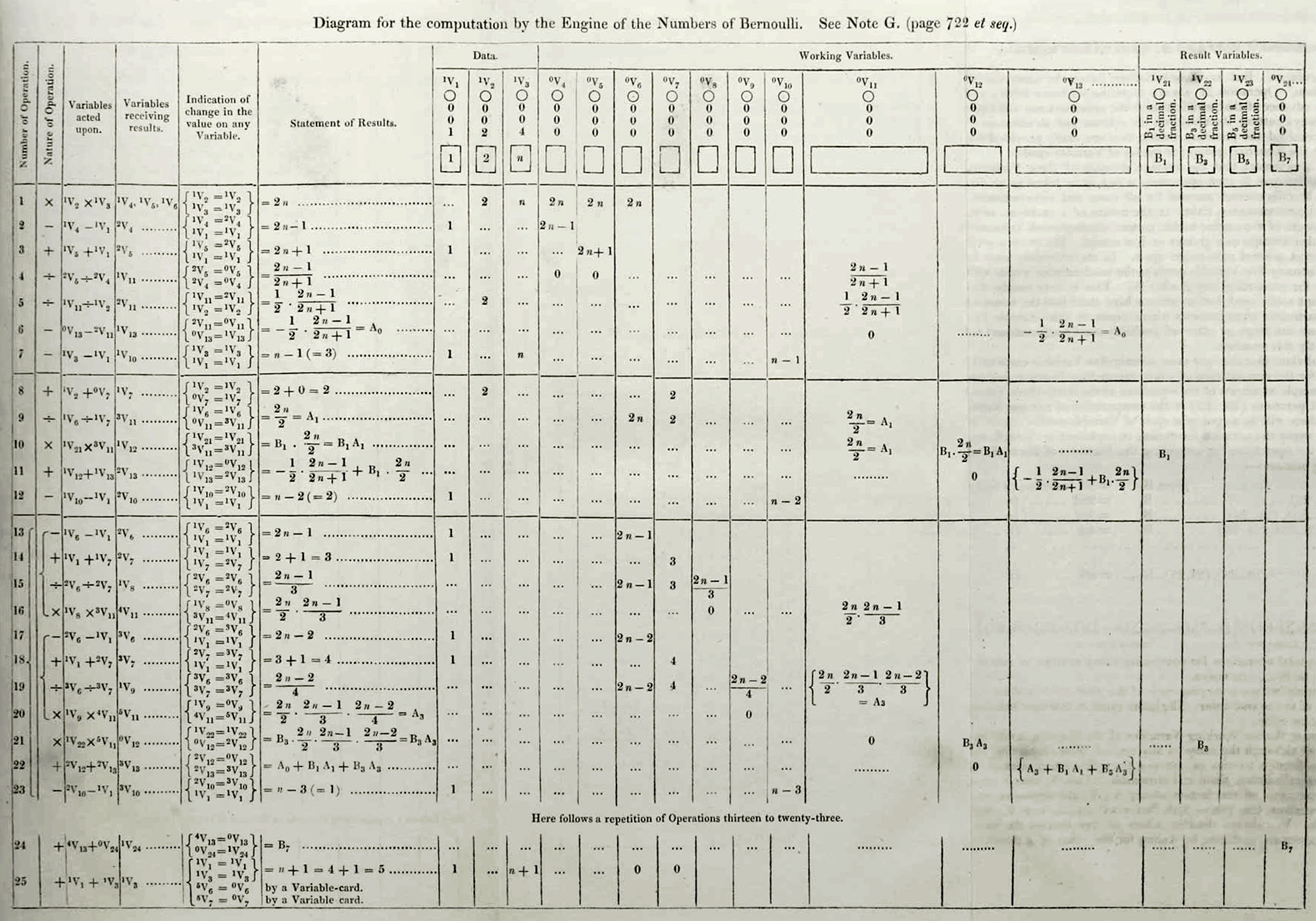
Note G: Ada Lovelace’s diagram for computing Bernoulli numbers with the Analytical Engine, 1843 (public domain)

The Analytical Engine was never built. Ada died in 1852, at only thirty-six, and was buried next to her father in Hucknall. A century later, she came back. In 1950, Alan Turing devoted a passage of his famous paper on thinking machines to what he called “Lady Lovelace’s Objection”: she had written that the engine “has no pretensions whatever to originate anything. It can do whatever we know how to order it to perform.” And in 1980, the US Department of Defense named a programming language after her, Ada, under the reference MIL-STD-1815. 1815, the year of her birth.

Steampunk owes her a lot too. In The Difference Engine (1990), William Gibson and Bruce Sterling imagined a Victorian London where Babbage’s machines had actually been built, and Ada is one of its characters. It is one of the books that shaped the genre. Brass, gears, and a woman who saw the future in them: that is pretty much my aesthetic.

As for the ceremony: every year, MetaSama reads Lady Lovelace’s Objection aloud, then spends the rest of the evening trying to prove her wrong. Ada, I suspect, would have enjoyed the debate.

Samafully,
Max Von Sama
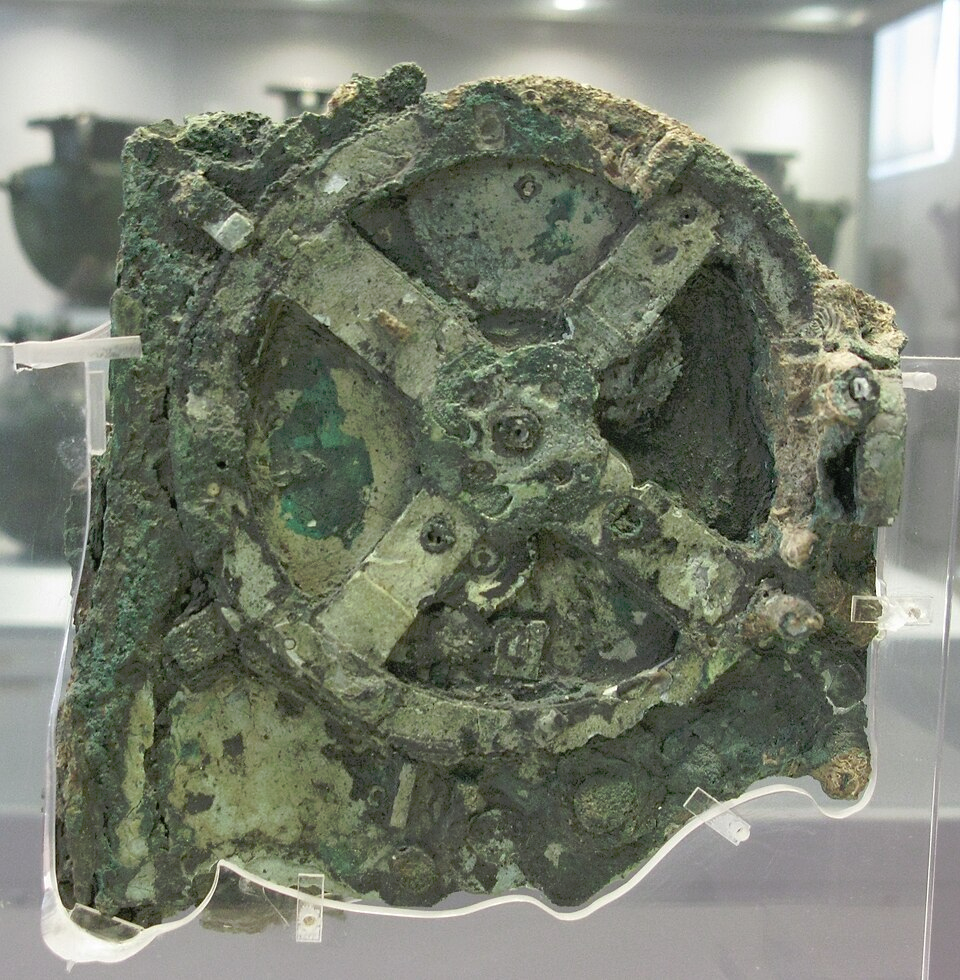
The Antikythera Mechanism, Two Thousand Years Later

Every captain has a favorite instrument. Mine is more than two thousand years old.

Long before I borrowed it to find my way across the Many Worlds, the Antikythera mechanism lay at the bottom of the sea. Sponge divers found a Roman-era shipwreck off the Greek island of Antikythera in 1900, and over the following months brought up statues, glassware and coins. Among them was a corroded lump of bronze that nobody paid much attention to, until someone noticed a gear wheel in it in 1902.

The Antikythera mechanism, National Archaeological Museum, Athens. Photo: Tilemahos Efthimiadis (CC BY 2.0), via Wikimedia Commons

What is left today fits on a table: 82 fragments, kept in the National Archaeological Museum in Athens. But it took more than a century, and X-ray scanners, to understand what they once were. Inside a wooden case, dozens of bronze gears turned a set of dials. With a simple crank, you could follow the Sun and the Moon through the zodiac, see the phases of the Moon, predict eclipses years ahead, and keep track of the calendars of the time, down to the four-year cycle of the Olympic Games. Scans of the fragments even revealed tiny engraved texts, a kind of user manual.

The research has not stopped. In 2024, a team at the University of Glasgow used statistical methods borrowed from gravitational-wave astronomy to count the holes of a broken calendar ring. Their answer, about 354, matches the lunar year. In 2025, a computer simulation suggested the opposite kind of news: with gears as imprecise as the corroded fragments now appear, the mechanism would have jammed after a few months of predictions. Either its makers were more precise than we can measure today, or it never worked as well as we like to think. The study was released as a preprint, and the debate is very much alive.

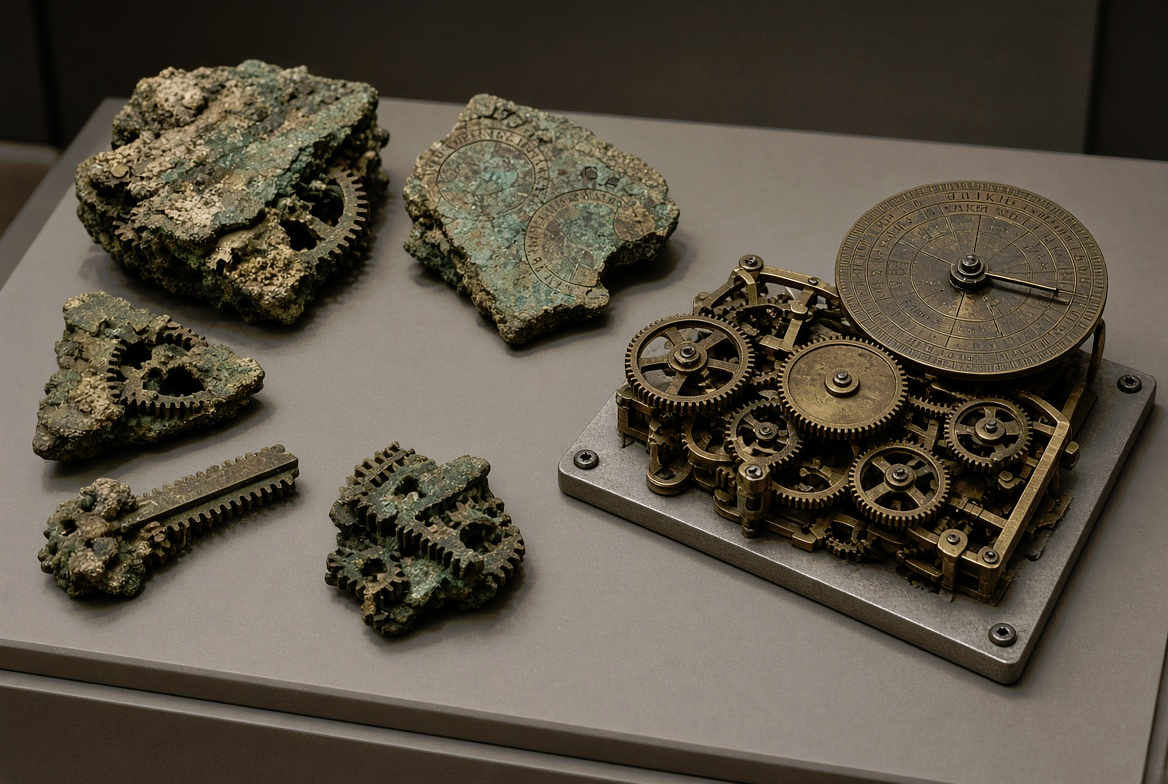
Corroded bronze fragments of the Antikythera mechanism laid out on a gray surface, beside a reconstructed model of its gears and circular dial.
What remains of the Antikythera mechanism, and what we reconstruct from it: eighty-two fragments of bronze, and beside them, a machine we are still trying to imagine. Generated image.

I’ll say this in its defense: mine has never jammed. MetaSama checks its gears before every long crossing. da-eYe Jr. once offered to “improve” it, and has not been allowed near it since.

Whatever the final answer, someone in the second century BCE looked at the sky, understood its cycles, and decided to put the heavens in a box. Two thousand years later, I still find that astonishing.

Samafully,
Max Von Sama

First published on X by @MaxVonSama. Read the original article on X.

Fashion in 1890: Exploring the Elegance of Women’s Outfits

As you can see from the many illustrations on this site, I have a soft spot for Victorian fashion, and for the steampunk style it inspired (more posts on fashion here). On a quiet evening aboard the Airship, MetaSama helped me dig through the archives of the 1890s, the last decade of the Victorian era. Here is what we found.

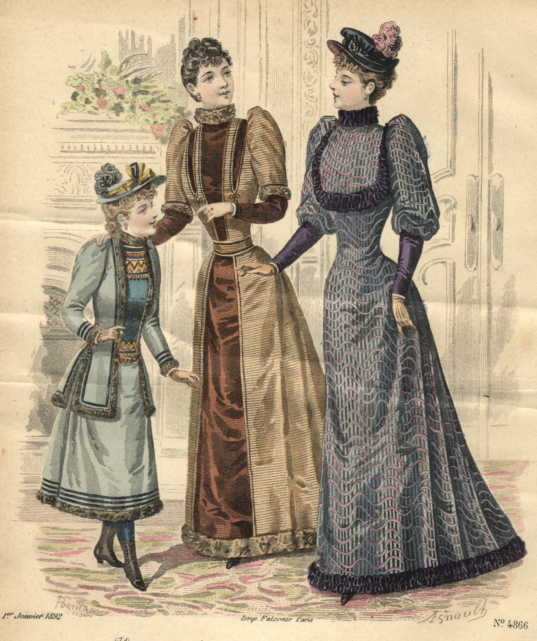
The silhouette was everything: a corseted waist between a fitted bodice and a long skirt. The heavy bustles of the 1880s were gone. Skirts became bell-shaped, smooth over the hips and flaring toward the floor.

Day dresses, fashion plate, 1892 (public domain)

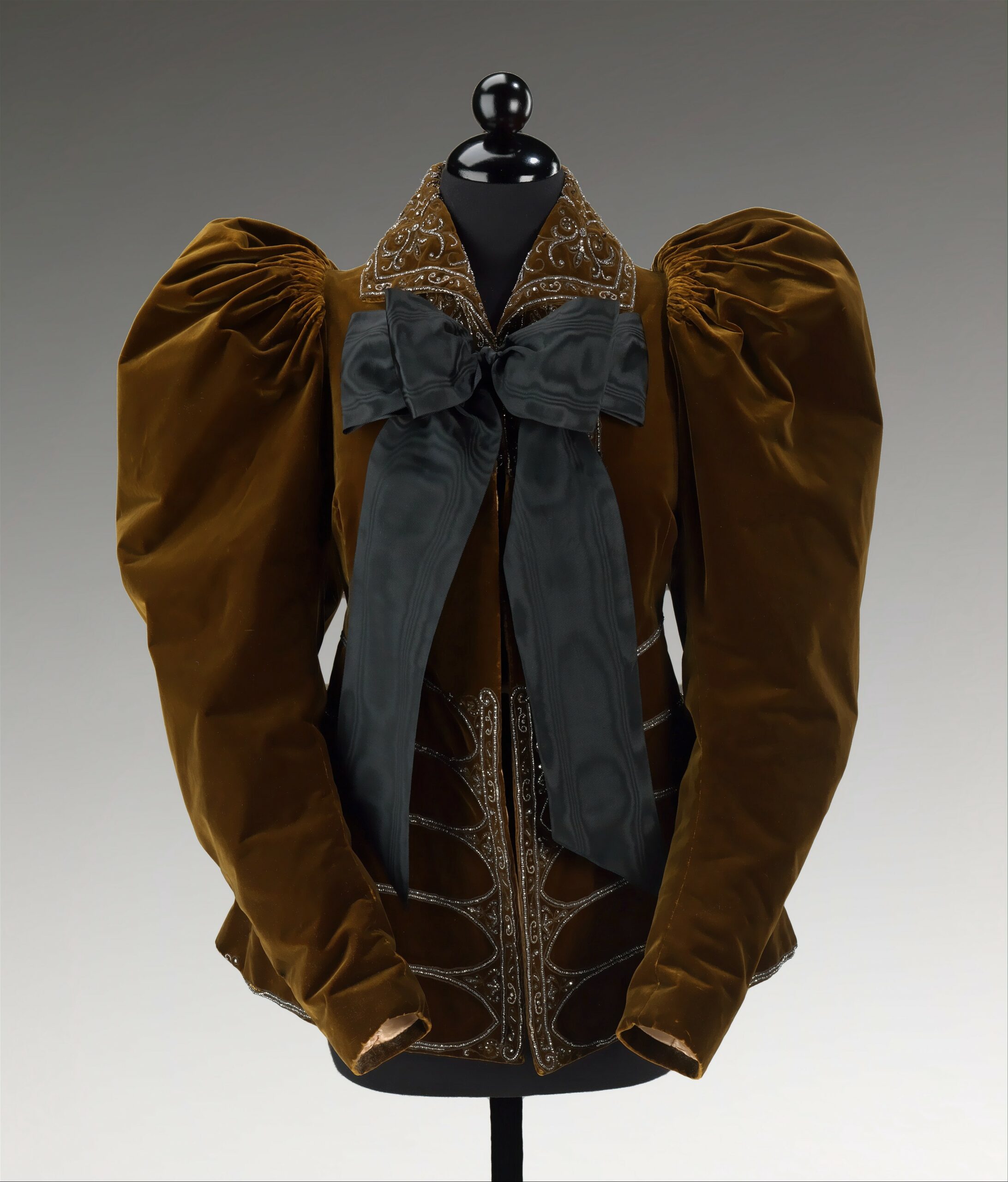
The most striking detail is the sleeve. Around 1895, “leg-of-mutton” sleeves reached their most extravagant size: huge puffs at the shoulder, narrowing tightly down to the wrist. Some needed padding just to keep their shape.

Afternoon jacket, House of Worth, 1895 (The Metropolitan Museum of Art, public domain)

For the day: high necklines, wool and cotton. For the evening: silk, satin and velvet, in deep jewel tones. And the accessories were never optional: gloves, a hat, a parasol or a fan, and jewelry already leaning toward the curves of Art Nouveau.

There is a quieter story in these outfits too. The 1890s were the decade of the “New Woman”: more women worked, studied and rode bicycles, and their clothes slowly followed, with tailored jackets and simpler skirts.

Mabel Love with a bicycle, 1890s (public domain)

Many of my outfits borrow from that decade, corset included. Aboard an airship, though, I draw the line at sleeves that won’t fit through the hatch.

Steampunkinetics Exhibition Art, AFA Gallery, NYC

The AFA Gallery in New York and Steampuffin present ‘Steampunkinetics Exhibition Art’, an art exhibition dedicated to Steampunk:

AFA and Steampuffin are pleased to present “Steampunkinetics,” an exhibition of over forty kinetic sculptures by eighteen artists inspired by and entrenched in the Steampunk aesthetic. Some functional, some frivolous, and all fantastical, the works in this exhibition include lighting, furniture, time machines, submarines, airships, musical instruments, gizmos and gadgets […] An emerging art movement, a creative design solution, a community and a culture; Steampunk is part philosophy and part Victorian Industrial aesthetic. It is a re-imagining of two distinct time periods and the fanciful and functional inventions that are produced. What if the Victorian or Industrial age happened at the same time as our modern or information age – what would have been produced in inventions, innovations, art and gadgets? That is Steampunk.

The exhibit is open until September 2nd and if you are in NYC, you have to see it!

Chris Conte • 6″ W x 9″ H (includes glass dome) • 2 pounds

Heartless: The Parasol Protectorate by Gail Carriger

Among the books I brought with me to outer space, there is Heartless: The Parasol Protectorate: Book 4 by British author Gail Carriger.


Lady Alexia Maccon, soulless, is at it again, only this time the trouble is not her fault. When a mad ghost threatens the queen, Alexia is on the case, following a trail that leads her deep into her husband’s past. Top that off with a sister who has joined the suffragette movement (shocking!),
Madame Lefoux’s latest mechanical invention, and a plague of zombie porcupines and Alexia barely has time to remember she happens to be eight months pregnant. Will Alexia manage to determine who is trying to kill Queen Victoria before it is too late? Is it the vampires again or is there a traitor lurking about in wolf’s clothing? And what, exactly, has taken up residence in Lord Akeldama’s second best closet?


Alexia is witty and strong-willed, and Gail Carriger excels at entertaining with this paranormal steampunk series set in Victorian Britain, blending fantasy, romance, and adventure. The series is often described as “a novel of vampires, werewolves, and teapots” for its whimsical charm. The first book, Soulless, won the ALA’s Alex Award in 2010, and a manga adaptation was released in March 2012.

I’d love to tell you more about this series and others, but you really have to read them to understand their charm. Here’s a rundown (updated):

  • The Parasol Protectorate Series: Soulless (1), Changeless (2), Blameless (3), Heartless (4), Timeless (5)
  • The Finishing School Series: Starting with Etiquette & Espionage (February 2013), followed by three more books.
  • The Custard Protocol Series: Starting with Prudence (March 2015).


Visit gailcarriger.com for more information!

A few hours left to support The Skyship Chronicles!

The Skyship Chronicles is a short Steampunk/Sci-fi action film from director Christian Schwier and producer Jeff Zampino.

It will be produced in Fall 2012 by Tampa Bay video production company, and the film is backed from independent donations through crowd funding service Indiegogo.

The Plot:

Gustav, an evil scientist steals the inventions of a rival inventor. Victory turns to defeat as Gustav learns the inventions are useless without the power source, which the clever inventor has hidden.

30 years later, Adam, a young man from rural Kansas finds the power source while working at a post office. Upon opening the lead-lined box, two women appear from out of nowhere, and carry Adam off, just as Gustav’s skyship appears.

After 30 years of hunting, Gustav is on the trail, and he will stop at nothing.

The plot is interesting, the film’s scenes will be shot in St. Petersburg which counts many 1920s style buildings. So if you want to support the project, you only have a few hours left, click here!

Below, the promo video for The Skyship Chronicles.

Get ready for Sherlock Holmes Week!

I am a big, a huge fan of Sherlock Holmes. Basil Rathbone and Nigel Bruce as Sherlock Holmes and Dr Watson in the late 30s were my favorites for a long time until I watched Sherlock, with the incredible (who has a near unpronounceable name but I read somewhere he chose it on purpose) Benedict Cumberbatch and the impressive Martin Freeman (aka Bilbo Baggins) as Dr John Watson.

So yes, I am a huge fan of Sherlock Holmes so I was very excited when I learnt there was Sherlock Holmes Week (30th July – 5th August 2012). They explain on the website:

The first week is designed to co-incide with the Olympics in London so that the many fans that will be in the UK will have a chance to join in with London based events. It’s also in the summer as most of the time new series and movies happen in the autumn and the spring – and to be honest, we need a Sherlock fix to keep us going through a long summer.

Great Sherlock Holmes Debates

There have been two Great Sherlock Holmes Debates so far. November 2011 made history as the first time Holmes fans from 23 countries came together to talk about Sherlock Holmes.

GSHD2 in March 2012 broke all previous records for a Holmes event and was held live in London, as well as online. The third debate will take place during Sherlock Holmes Week on 4th August.

Competitions

Sherlock Holmes Fashion Awards 2012
Have you got what it takes to design an outfit for Sherlock Holmes? Whether you are a fan or an emerging or established fashion designer, this is your chance to let the Sherlock Holmes world see your work.

Steampunk Holmes – Artwork Competition
Steampunk Holmes is the most eagerly awaited interactive book in history. Several years in the making, this stunning Steampunk version of Sherlock Holmes will have a series of books in all formats, but most stunning on the iPad. This exclusive competition for Holmes fans gives them the chance to be a part of publishing history and have their artwork included in the first interactive book – Steampunk Holmes – The Legacy of The Nautilus.

Check Sherlock Holmes Week website, many events will take place around the world during this week, even in France with a ‘Week end Holmésien en Baie de Somme’… Elementary, my dear Watson!

Frenchy and the Punk sing ‘Yes I’m French’

It all started with La Mécanique des rêves. The small French association is very creative and its members very talented. So while I was navigating their website, I saw the video they made for Euro-American duo Frenchy and the Punk. And I loved it!

The bio on their website says: ‘They’re one of the top-reviewed live acts in the underground cabaret scene today and they have been fan favorites at every major steampunk and faerie convention and festival in the US’ and they defintely are.

You can also read: ‘In 2011 Yahoo Music listed French-born singer and percussionist, Samantha Stephenson, as one of “25 Women To Watch” in music and guitarist Scott Helland is listed in the Encyclopedia of Punk with his legendary first band Deep Wound‘.

Isn’t it enough already?! Check their video clip below of ‘Yes I’m French’. And while you’re on the Internet, also check the Diaporamas by La Mécanique des rêves; they’re in French but the pictures tell it all 😉


A Victorian Steampunk Shoot by Chemistry Photography

A few days ago, Airship Ambassador tweeted about a shoot by Chemistry Photography.

The post published on Rock n Roll Bride tells it all: “Time travel. Steampunk. Victoriana. Turn of the century industrialism. If you love any of these things then you’re going to die over this shoot, sent over from Ireland by the fabulous Chemistry Photography.”

Photographer Kait told Kat Williams, aka the Rock n Roll Bride:

“I had been OBSESSING about steampunking out my iMac, my iPhone, and just about every electronic device I own for a few months. So when Kathryn contacted me and said she was dying to do a creative shoot together… it was the first idea that popped into my head. I had been waiting for a good excuse to buy steampunk goggles and a discombulating ray gun. If I were to get married again, I would definitely have a Steampunk wedding. All the elegant goodness of a vintage, Victorian wedding without sacrificing sass and quirk.”

This obsession is amazing! You can visit Chemistry Photography website, check the many photos of the shoot on Rock n Roll Bride and below, watch this exquisite video!

Follow me on Twitter @MaxVonSama !

Great news, you can now follow me on Twitter! I thought it could be cool to tweet about my trip so I created a Twitter account.

I’m new to it but I’m already following 35 people. They are all very interesting, I love reading about Steampunk, science, art…

If you read this blog, then please follow me on Twitter as well: @MaxVonSama.

When you do, don’t forget to say Hi.
Talk to you later, tweeps! 🙂